

Soil Heating Cables: How Root Zone Warmth Changes Everything
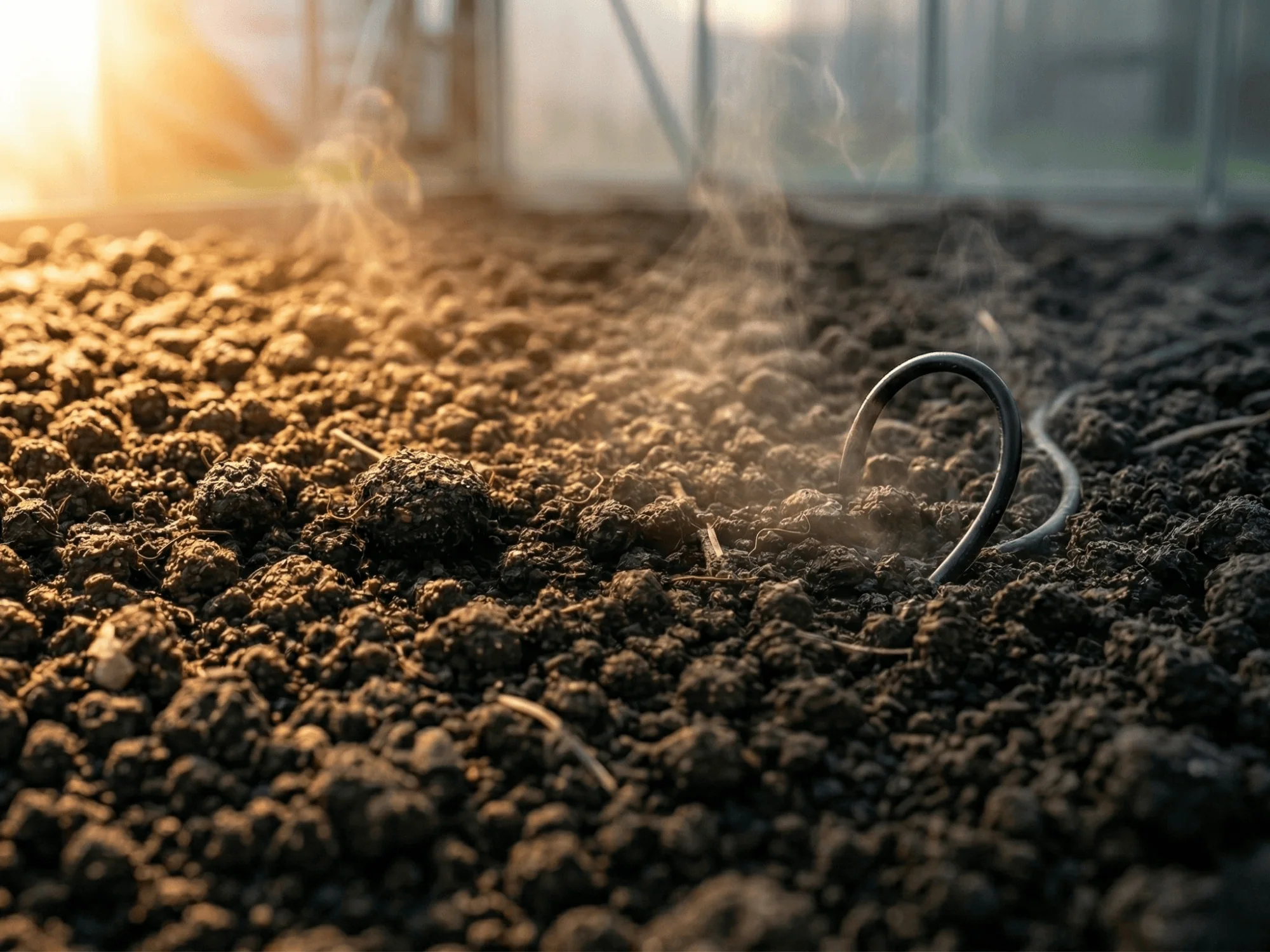
Most growers focus on air temperature. But what is happening at root level can matter just as much. A look at how soil cables work and when they pay off.
Air temperature is what most growers watch and what most thermostats control. It is the obvious number — the one on the display, the one that tells you whether the heater is doing its job. But for a plant, the temperature at the root zone is just as critical, and in a cold-climate greenhouse the two numbers can be very far apart.
Soil heating cables address the root side of that equation directly. Here is what they actually do and how to think about whether they make sense for your setup.
Why root zone temperature is its own problem
In a greenhouse through winter, air temperature can be reasonably well managed with a heater. But the ground is a different matter. Soil and growing media are in direct contact with the cold earth below the structure — or, in raised beds and benches, with the cold air underneath them. Heat rises, which means the warmest air in the tunnel is at the peak and the coldest zone in the space is right where the roots are sitting.
Cold roots slow everything down. Nutrient uptake becomes less efficient because the biological and chemical processes that move nutrients from soil into root tissue are temperature-dependent. Germination rates drop significantly below certain soil temperatures — most warm-season crops want root zone temps above 65°F to germinate reliably, and many will stall or fail entirely below 60°F even if the air above them is perfectly warm. Transplants put into cold soil take longer to establish, and seedlings grown in cold media are slower to develop regardless of what the air thermostat says.
Warming the air does help the soil eventually — heat conducts down over time — but it is slow, energy-intensive, and inefficient. You end up heating the whole volume of air in the tunnel to push warmth down to the ground, when what you actually needed was warmth at the ground specifically.
What a soil heating cable does
A soil heating cable is a resistance wire — similar in principle to an electric blanket — that is buried a few inches below the surface of a growing bed or propagation area. When current runs through it, it generates heat directly in the zone where you need it. The cable does not heat the air. It does not heat the whole structure. It puts warmth precisely at root level and lets the growing media hold it there.
The result is that you can maintain a 65 or 70°F root zone in a propagation bench while the air temperature in the tunnel is 10 or 15 degrees cooler. That changes the economics of winter growing considerably. Instead of running the main heater hard enough to warm the entire interior to a temperature that keeps roots happy, you run it to a lower threshold for plant survival and let the cables handle the root zone temperature independently.
The wattage matters more than the cable length. Soil heating cables are rated by wattage per linear foot. A cable with too low a watt density in a cold climate will struggle to maintain setpoint against ground cold. As a rough guide, propagation benches and seedling flats in cold climates typically need 10 to 18 watts per square foot of bed area. If you are in a milder climate or only need a modest boost, the lower end of that range is sufficient.
Where they are most effective
Propagation and germination areas:
This is the most common and highest-return application. Germination is highly sensitive to soil temperature, and a heated propagation bench allows you to start seeds reliably weeks earlier than you could in unheated media. The cable area is small, the power draw is modest, and the benefit to germination rates and seedling development is immediate and measurable.
Early transplant beds:
Getting transplants established quickly in late winter or early spring is where a lot of cold-climate growers lose time. Young plants put into cold soil stall while their roots adjust. Cables under transplant beds maintain a root zone temperature that keeps establishment moving at a normal pace rather than waiting on the season.
Overwintering sensitive crops:
Some crops — certain herbs, tropical varieties, perennial starts — can survive cold air temperatures better than they can survive cold roots. A heated root zone lets you overwinter plants that would otherwise need to come inside entirely, at a fraction of the energy cost of heating the whole structure to a warm enough temperature.
Installation basics
Cables are typically laid in a serpentine pattern across the bed area at a consistent spacing — usually 3 to 4 inches apart — and buried 2 to 3 inches below the surface. Closer spacing gives more even heat distribution; wider spacing reduces cost but can create temperature gradients across the bed. The cable connects to a thermostat probe buried at the same depth as the cable, which controls the circuit and keeps the soil temperature at setpoint rather than running continuously.
Do not cross the cables or allow them to touch each other — overlapping concentrates heat and can damage the cable. Leave the ends of the cable accessible and never cut a heating cable to length; they are manufactured to a specific resistance for a specific wattage and shortening them changes the load and can cause overheating.
Pairing cables with a thermostat through the Sunny app
Soil heating cables work best when they are connected to a dedicated soil temperature thermostat rather than running on a simple timer or continuously. A probe thermostat buried at root depth reads actual soil temperature and cycles the cable on and off to hold a setpoint — much more precise than guessing at run time, and far more energy-efficient than running the cable around the clock.
To pair and configure your thermostat controls, download the Sunny app. You can set your root zone temperature targets, configure alerts if the soil temperature drops below a safe threshold overnight, and monitor performance across your beds from your phone. If your greenhouse does not have Wi-Fi coverage, you can set up your automations and temperature schedules indoors using your phone's cellular hotspot, or preset everything before installation so the thermostat runs its programmed schedule without needing an active connection on site.