Intake vs. Exhaust Fans: Why You Need Both
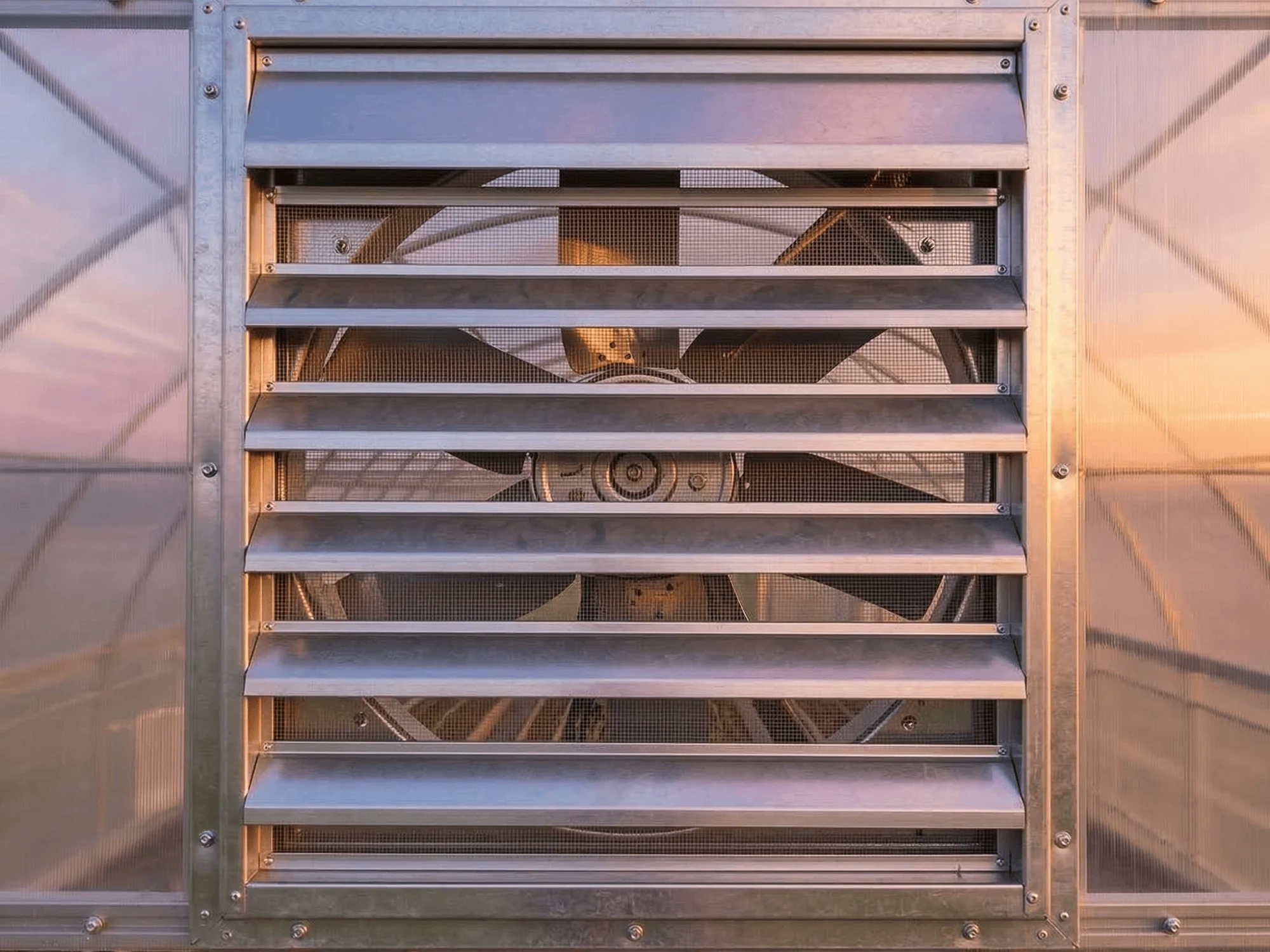
One pulls fresh air in, the other pushes stale air out. Running both together keeps your airflow balanced and your crops healthier.
A single fan in a greenhouse moves air. Two fans — one intake, one exhaust — create an airflow system. The difference matters more than it might seem, and it is one of the more common ventilation mistakes growers make when setting up a tunnel for the first time.
What each fan actually does
An exhaust fan is mounted at one end of the structure, typically up high near the peak where heat collects, and it pushes air out of the greenhouse. As it does, it creates a slight negative pressure inside — the interior has less air pressure than the outside, which naturally draws fresh air in through any opening on the opposite end.
An intake fan does the reverse. It is mounted at the opposite end, lower in the structure, and it actively pulls fresh air in from outside. Together, the two fans create a defined airflow path: fresh air enters at one end, travels the length of the tunnel across the crop zone, and exits at the other end. Hot air at the peak is pushed out, CO₂-depleted air near the canopy is replaced, and humidity that builds up around the leaves is moved through rather than sitting stagnant.
Running only an exhaust fan without a dedicated intake relies on passive infiltration to supply replacement air — through roll-up vents, door gaps, or whatever openings are available. This works to a degree, but it gives you no control over where the fresh air enters or what path it takes through the space. In a long tunnel, the air exchange can be uneven, with good ventilation near the doors and sluggish, stale air in the middle of the run.
Why stale air is a real crop problem
Plants consume CO₂ during photosynthesis. In a sealed or poorly ventilated greenhouse on a sunny day, CO₂ levels around the canopy can drop low enough to meaningfully slow photosynthesis — not dramatically, but consistently enough to affect growth rate and yield over a season. Fresh air exchange keeps CO₂ levels from depleting at the leaf surface.
Humidity is the other side of the problem. Plants transpire constantly, releasing moisture into the air around them. In a closed or under-ventilated space, relative humidity climbs and the air immediately around the leaves becomes saturated. That saturated boundary layer reduces the plant's ability to transpire effectively, which slows nutrient uptake and creates exactly the warm, wet conditions that fungal diseases need to establish. Moving air through the canopy disrupts that boundary layer and keeps transpiration working as it should.
Airflow direction matters. The standard setup for a tunnel greenhouse is exhaust at the far end, high in the structure, and intake at the near end, lower down. This pushes air along the length of the tunnel from bottom to top — fresh air enters at crop height, warms and picks up humidity as it travels, and exits at the peak. Reversing this, or placing both fans at the same end, short-circuits the airflow path and leaves most of the tunnel poorly ventilated regardless of fan capacity.
Sizing the fans to the structure
Fan capacity is measured in CFM — cubic feet per minute. The basic sizing calculation starts with the volume of the greenhouse: multiply the length by the width by the average interior height to get cubic feet, then size your exhaust fan to turn over that volume at least once per minute in warm weather. For a 30 by 100 foot tunnel with an average interior height of around 10 feet, that is roughly 30,000 CFM of exhaust capacity needed at peak ventilation.
The intake fan does not need to match the exhaust fan exactly. A common approach is to size the intake at roughly 80 to 85 percent of the exhaust capacity. This maintains a slight negative pressure in the structure — the exhaust fan is pulling marginally harder than the intake is pushing — which keeps the airflow moving in the right direction and prevents back-drafting on the intake side.
Both fans should be on thermostats rather than running continuously. The exhaust fan typically has a staged thermostat — a lower setpoint for the first stage at reduced speed, and a higher setpoint that brings it to full capacity. The intake fan stages with it. This keeps the system from running at full power on mild days when a small amount of air exchange is all that is needed.
Roll-up side vents and passive ventilation
Fans handle the active ventilation load, but the roll-up side vents on both sides of the tunnel are still a key part of the overall system. On mild days, the vents alone may be enough — opening both sides creates cross-ventilation that can move a significant volume of air without running the fans at all. On hot days, opening the side vents while running the fans increases the total ventilation capacity of the structure and gives the fans more surface area to work with.
The end doors serve the same supplemental role. On very hot days, opening the doors at both ends in addition to the side vents and running both fans gives you maximum possible airflow through the structure. This combination — fans running, side vents open, doors open — represents the full ventilation capacity of the tunnel and is what most growers rely on during peak summer temperatures.
Automating your fans with the Sunny app
The most reliable way to run intake and exhaust fans is on automated temperature controls rather than manual switching. Connecting your fan thermostats through the Sunny app lets you set your temperature thresholds, configure staged fan speeds, and monitor interior conditions from your phone. You can also set alerts for when the temperature climbs above a threshold — useful for catching a situation where fans have failed or vents have not opened correctly on a hot day.
If your greenhouse does not have Wi-Fi coverage, use your phone's cellular hotspot to pair the thermostats and set up your automation schedules through Sunny during installation. Once the schedules are programmed, the thermostats run them locally without needing an active connection. Alternatively, set everything up indoors on Wi-Fi before mounting the units in the structure — the programmed logic stays on the thermostat regardless of whether it is connected to the network.