How to Start Seeds in Trays Without Losing Half of Them
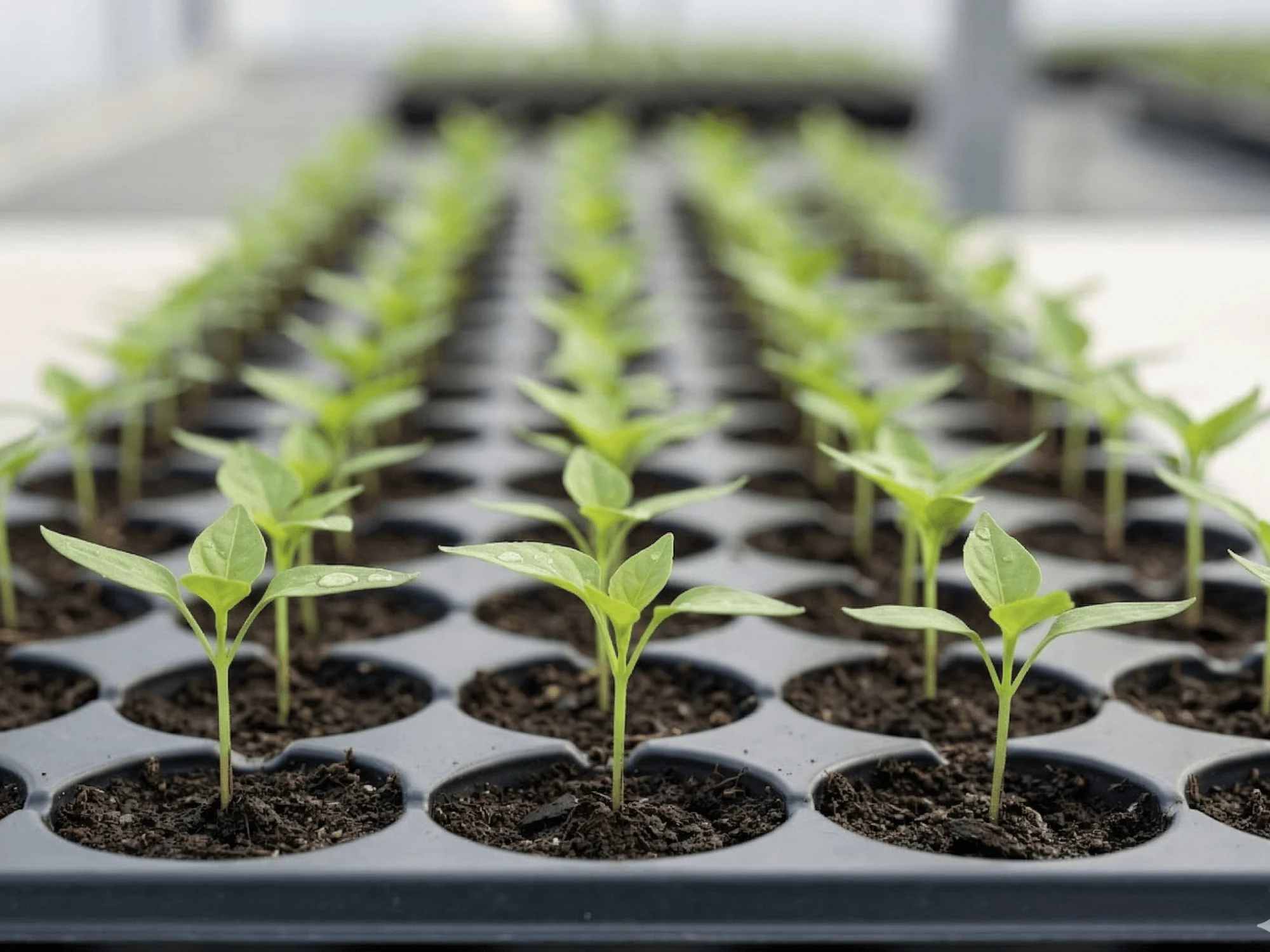
Germination rate is mostly about consistency. Here are the small things that make a big difference when starting seeds at scale.
Poor germination rates in trays almost always come down to the same handful of issues — media that is too wet or too dry, temperatures that fluctuate too much, sowing depth that is off, or trays that dry out unevenly and get abandoned before anything has had a fair chance to emerge. None of these are complicated problems, but they compound. Fix all of them and germination rates improve dramatically. Leave any one of them unaddressed and it pulls down everything else.
Here is what to pay attention to from the point the seed goes in until it is ready to move on.
Start with the right media
Seed starting media is not the same as potting mix and it is not garden soil. It needs to hold moisture consistently without becoming waterlogged, drain freely enough that roots get oxygen, and have fine enough texture that a small emerging root can push through without resistance. Standard potting mixes often have bark chunks or perlite in proportions that are fine for established plants but too coarse for germination. Garden soil compacts in trays and drains poorly.
A purpose-built seed starting mix — finer texture, lighter structure, minimal fertiliser — gives seeds the best starting conditions. High fertiliser content in the media is not an advantage at the germination stage and can actually inhibit some species. Seeds carry enough stored energy to germinate without any supplemental nutrition; what they need is moisture, warmth, and physical conditions that let the root emerge and anchor without impediment.
Moisture at sowing: wetter than you think, but not waterlogged
The most common germination mistake is sowing into media that is not moist enough from the start and then trying to water from the top after the seeds are in. Top-watering freshly sown trays displaces seeds, drives them deeper than intended, and creates uneven moisture distribution. The right approach is to pre-moisten the media before filling the trays — mix water in thoroughly until the media holds together when squeezed but does not drip. Fill the cells, firm gently, sow, and cover. The media should be uniformly moist from the start without needing immediate watering.
From that point, the goal is to keep the surface from drying out without waterlogging the cells. A humidity dome over the tray slows evaporation significantly and reduces how often you need to water during the germination period. Once seeds start emerging, remove the dome to prevent the excess humidity from encouraging damping off — the fungal collapse at the stem base that wipes out seedlings fast once it takes hold.
Bottom watering is better than top watering for trays. Set the tray inside a shallow reservoir of water and let the media absorb moisture from below for 20 to 30 minutes, then remove it. This keeps the surface from being disturbed, waters every cell evenly, and avoids keeping the top of the media constantly wet — which is the main condition that encourages damping off and fungal issues at soil level.
Soil temperature is what actually drives germination
Air temperature matters, but soil temperature is what the seed responds to. Most warm-season crops — tomatoes, peppers, cucumbers, melons — germinate best with a soil temperature between 70 and 85°F. Cool-season crops like lettuce, spinach, and brassicas are more tolerant of lower temperatures but still have a viable range below which germination slows dramatically or stops.
In a cool greenhouse in early spring, a heated propagation bench or soil heating cables under the trays can make an enormous difference to germination speed and uniformity. Consistent soil warmth — held steady at the right range by a thermostat probe rather than guessed at — shortens germination time, improves uniformity across the tray, and gets seedlings to transplant size faster. Trying to compensate with warmer air temperature is less efficient and less effective than warming the media directly.
Sowing depth: less is usually more
A general rule is to sow at a depth of approximately twice the diameter of the seed. Very small seeds — lettuce, basil, celery — need to be at the surface or barely covered, as they require light to germinate and cannot push through more than a thin layer of media. Larger seeds like squash, beans, and sunflowers go deeper, but even these rarely need more than an inch.
Sowing too deep is a more common problem than sowing too shallow. A seedling that has to push through twice as much media as it needs to uses up its stored energy reserves before it reaches the surface, emerges weak, and often stalls or fails shortly after. When in doubt, go shallower and compensate with consistent moisture rather than depth.
Label everything, including the date
At small scale this feels unnecessary. At commercial scale — or even a few dozen trays across a season — unlabelled trays become a real problem fast. Species that look identical at the cotyledon stage, different sowing dates for succession planting, varieties with different transplant timings — all of this requires labels. Include the species, the variety if it matters, and the sowing date. The sowing date in particular tells you when to start worrying that germination is behind schedule and when a tray can be written off and resown rather than waited on indefinitely.
Thinning is not optional
Multi-seeding cells — putting two or three seeds per cell to guarantee at least one germinates — is a reasonable hedge when germination rates are uncertain. But once germination has happened, leaving multiple seedlings in a cell is not a neutral choice. They compete for moisture, nutrients, and light from the very start, and the resulting seedlings are weaker than a single plant grown with the full cell volume to itself.
Thin to one seedling per cell as soon as you can identify the strongest plant, and do it by cutting at soil level rather than pulling — pulling risks disturbing the roots of the seedling you are keeping. It is a difficult habit to build when the seedlings look healthy, but the transplant performance of single-stem seedlings versus crowded ones is consistently better.
What to do when germination is uneven
Some unevenness across a tray is normal — not every cell germinates on exactly the same day. But if germination is patchy across a whole tray after the expected window has passed, the cause is almost always one of three things: uneven moisture in the media when sowing, uneven temperature across the bench, or variable sowing depth. Check the remaining cells before writing the tray off — press gently on the surface near slow cells and look for any sign of swelling or cracking that indicates germination is underway but slow. If there is nothing after significantly more time than the expected germination window, resow rather than waiting further.
Consistency is the theme across all of it. Media moisture, soil temperature, sowing depth, and watering method — keep all four controlled and uniform, and germination rates follow. Let any one of them vary tray to tray or cell to cell and the losses add up.