Understanding Snow Load Ratings: What Your Greenhouse Actually Needs to Survive Winter
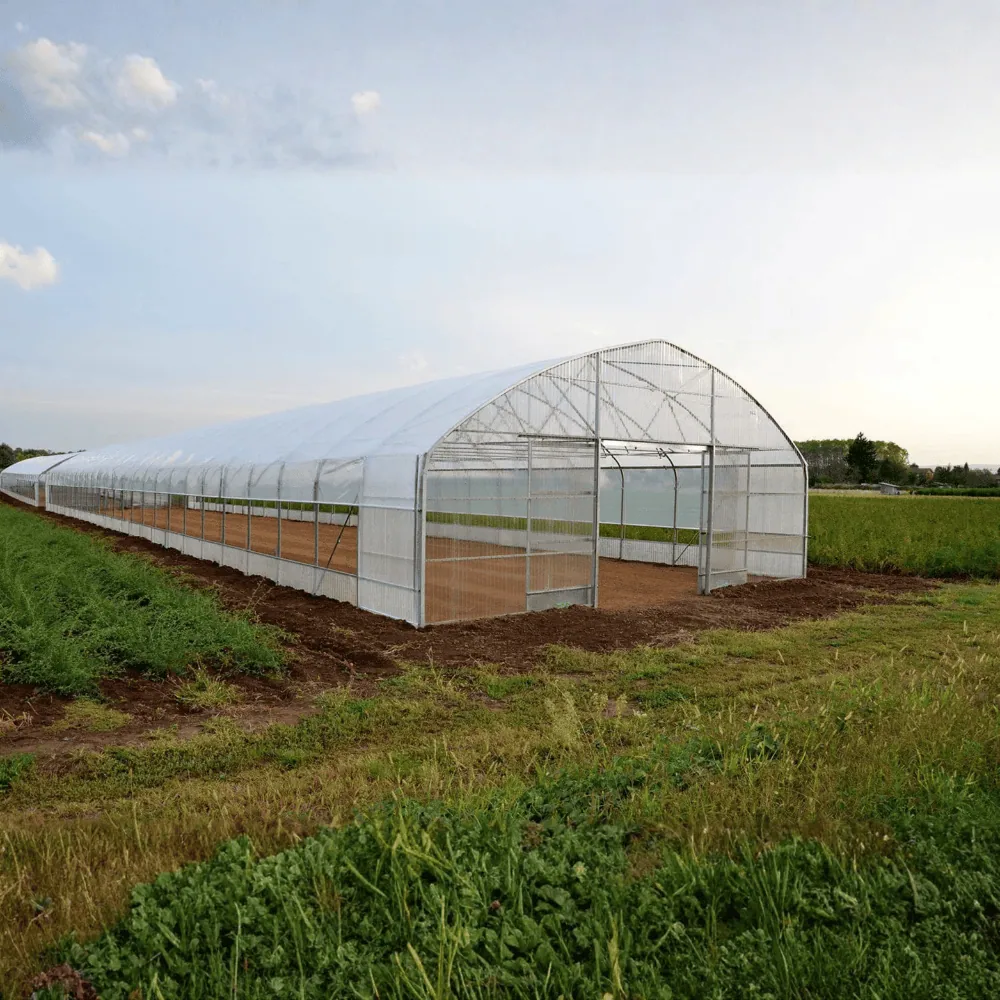
Not all greenhouses are built for the same winter. Arch spacing and pipe diameter are the numbers that matter.
A snow load rating is not a marketing number. It is the structural threshold beyond which your greenhouse frame starts to fail. Here is how to read it, find your zone, and match a structure that will still be standing in March.
Every winter, growers lose greenhouses to snow. Most of those collapses were not caused by unusual weather events — they happened because the structure was not rated for the conditions that region sees in a typical year. The grower bought on price, assumed the word "commercial" in the listing meant something structural, and found out in February that it did not.
Snow load ratings exist precisely to prevent this. They are a standardized way of measuring how much distributed weight a roof can carry before it fails — and once you understand the numbers, choosing the right structure becomes considerably more straightforward.
What snow load actually means
Snow load is measured in pounds per square foot (PSF) in the United States and Canada uses kilopascals (kPa) — though most greenhouse specifications are quoted in PSF because it is more intuitive for growers. The number represents the cumulative weight of snow that can accumulate on a given square foot of roof surface before the structure is at risk of deformation or collapse.
It is important to understand that we are talking about roof snow load, not ground snow load. These are different figures. Ground snow load is what falls on flat open land; roof snow load accounts for the curved geometry of a tunnel structure, which tends to shed snow more efficiently than a flat surface — but only up to a point, and only if the slope is steep enough and the snow is not wet and dense.
Key distinction: Wet, compacted snow weighs roughly 20–30 lbs per cubic foot. Fresh, dry powder might weigh 3–5 lbs per cubic foot. A 6-inch layer of wet snow can carry the same load as 18–24 inches of powder. Your structure needs to handle the worst case your region sees, not the average.
How North American snow zones are defined
In the United States, ground snow load data is published under ASCE 7 (American Society of Civil Engineers, Standard 7). In Canada, the equivalent is the National Building Code of Canada (NBCC). Both standards define regional snow loads based on decades of historical data, and both use the same principle: the 50-year return period load, meaning the snow depth a region would expect to see or exceed once in fifty years.
Broadly speaking: coastal regions of BC, the Pacific Northwest, and much of the southern US fall into the Very Low to Low range. The interior of BC, Alberta, the northern Plains, and New England typically land in the Moderate to High range. Mountain regions — the Rockies, Sierra Nevada, and much of northern Canada — are Very High to Extreme. The only accurate way to know your specific location's number is to use a regional lookup tool; the figures vary significantly even within the same province or state.
You can find your exact zone using our Canadian Snow Load Calculator or US Snow Load Calculator — click your province, territory, or state and get the regional breakdown with structure recommendations.
What the structural specs actually tell you
When you look at a greenhouse listing, you will often see numbers like arch count, bay spacing, pipe diameter, and purlin runs. These are not just descriptive — they are the actual structural determinants of snow load capacity. Here is what each one means in practice.
Arch spacing (on-center distance): This is the distance between each hoop or arch along the length of the tunnel. Arches at 5ft on-center are Standard for moderate climates. The Lite tier opens spacing to 6ft (or 2m) on centre — engineered for near-snow-free zones where tighter spacing would be over-built. Tightening to 4ft on-center on Heavy means more arches over the same span, which distributes load across more structural members and dramatically increases the rated capacity. Heavy-spec structures use the tightest spacing; this is the single biggest contributor to higher snow ratings.
Pipe diameter and wall thickness: Commercial-grade greenhouse arches use structural steel pipe in the 2-inch to 3-inch range. Larger diameter means more moment of inertia — more resistance to bending under load. Thicker walls mean more material to resist buckling. This is where much of the cost difference between standard and heavy models lives, and it is not a cosmetic difference.
Purlin runs: Purlins are the horizontal members that run the length of the tunnel and connect the arches. More purlin runs mean the arches are laterally braced at more points, reducing the unsupported length of each arch and preventing lateral buckling. Standard models typically run 5 purlin runs; heavy models run 7, which is a significant structural improvement.
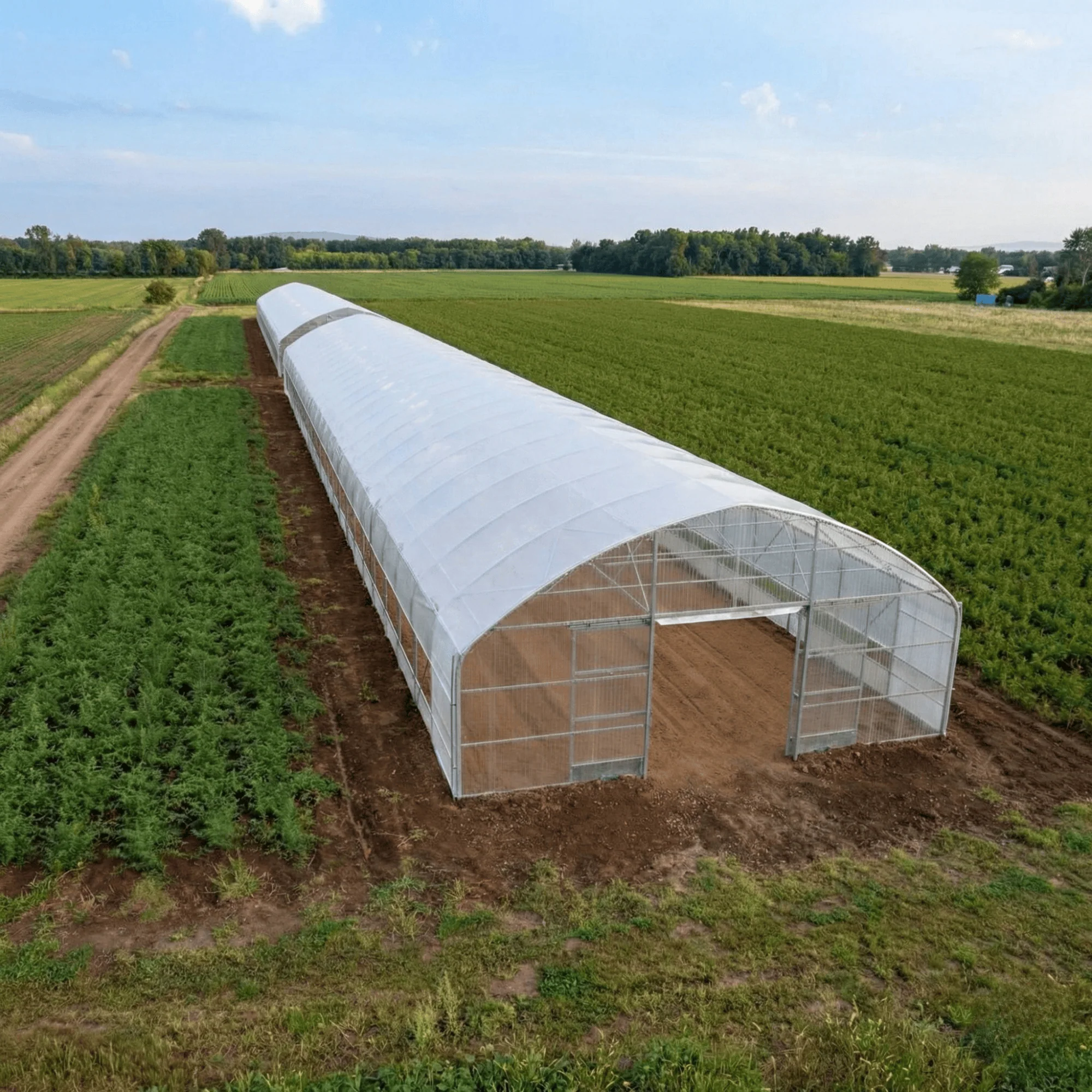
Arch spacing, purlin count, and pipe specification are what determine rated snow load — not the overall dimensions of the structure.
How our structures stack up across the zones
The table below maps each structure in our lineup against the snow load it is rated for and the climate zones it is appropriate for. Use your regional PSF figure from the calculator to find your match.
| Structure | Rated Roof Snow Load | Arch Spacing | Purlin Runs |
|---|---|---|---|
| 100' Hoop Lite | ~6 PSF | 6ft o.c. / 17 arches | 5 |
| 100' Hoop Standard | ~15 PSF | 5ft o.c. / 21 arches | 5 |
| 50' Hoop Standard | ~15 PSF | 5ft o.c. / 11 arches | 5 |
| 100' High Tunnel Lite | ~10 PSF | 2m (~6ft) o.c. / 17 arches | 5 |
| 100' High Tunnel Standard | ~25 PSF | 5ft o.c. / 21 arches | 5 |
| 50' High Tunnel Standard | ~25 PSF | 5ft o.c. / 11 arches | 5 |
| 30' Light Dep Lite | ~9 PSF | 6ft o.c. / 6 arches | 5 |
| 30' Light Dep Standard | ~25 PSF | 5ft o.c. / 7 arches | 5 |
| 24' HT Mini Lite | ~10 PSF | 6ft o.c. / 5 arches | 3 |
| 24' HT Mini Standard | ~35 PSF | 4ft o.c. / 7 arches | 3 |
| 24' HT Mini Heavy | ~45 PSF | 3ft o.c. / 9 arches | 3 |
| 24' Hoop Mini Lite | ~10 PSF | 6ft o.c. / 5 arches | 3 |
| 24' Hoop Mini Standard | ~21 PSF | 4ft o.c. / 7 arches | 3 |
| 24' Hoop Mini Heavy | ~28 PSF | 3ft o.c. / 9 arches | 3 |
| 100' Hoop Heavy | ~50 PSF | 4ft o.c. / 26 arches | 7 |
| 100' Multi-Span Lite | ~55 PSF | 1.87m (~6ft) o.c. / 17 arches | 5 |
| 100' High Tunnel Heavy | ~70 PSF | 4ft o.c. / 26 arches | 7 |
| 100' Multi-Span Standard | ~69 PSF | 5ft o.c. / 21 arches | 5 |
| 30' Light Dep Heavy | ~80 PSF | 4ft o.c. / 8 arches | 7 |
| 100' Multi-Span Heavy | ~90 PSF | 4ft o.c. / 25 arches | 5 |
If your region is rated at 30 PSF, for example, a Hoop Standard at 15 PSF is not adequate — full stop. It is not a question of whether the winter will be unusually bad; the standard was calculated specifically to include your expected worst-case year. A structure rated below your regional ground snow load is a structure that may fail in a normal winter.
What a collapse-risk structure looks like — the warning signs
Budget-priced tunnel greenhouses marketed online often use language that sounds structural without actually providing the data needed to assess whether the structure is appropriate for your climate. The pattern is consistent enough that it is worth naming directly.
To be concrete: a 30ft × 100ft tunnel greenhouse built on thin-wall 25mm pipe with 6mil EVA plastic — regardless of how it is marketed — is not a structure designed for sustained snow load. The pipe will buckle. The connections will fail. It may perform acceptably in a low-snow coastal environment if the roof is cleared after every storm, but it is not a structure that survives a week of accumulation in a Moderate or High zone without intervention. If you are in Alberta, interior BC, Quebec, or any state east of the Mississippi that sees real winters, this matters significantly.
An important note: A structure rated for 15 PSF does not slowly degrade when loads exceed that threshold — it fails. Structural failures under snow load tend to happen suddenly, often in the middle of the night or during a multi-day storm when no one is there to clear it. The cost of a collapsed greenhouse is not just the structure itself; it is the crop inside, the time lost, and the rebuilding during a season when you needed to be growing.
Lite, Standard, or Heavy: when does each matter?
If your region is rated under 10 PSF — coastal BC, much of California's coastal counties, the Pacific Northwest lowlands south of the snow belt — the Lite model is the right structural match and a Standard would be over-engineered for the load. The Lite tier was engineered exactly for near-snow-free climates: a full structure on Ø48 × 1.5 mm pipe at wider arch spacing, matched to the PSF the climate actually produces. Working climate protection without paying for steel the conditions do not require.
If your region is rated 10–20 PSF — coastal BC outside lowland zones, parts of California's foothills, the Pacific Northwest lowlands proper, southern US — a Standard model is appropriate and the added cost of a Heavy structure is not necessary. The Standard lineup was designed for exactly this use case: meaningful climate protection and season extension in climates where snow is occasional and light.
If your region is rated 20–35 PSF, you are in the range where choice matters. A High Tunnel Standard at 25 PSF will technically cover the low end of this range, but a Heavy model gives you meaningful margin. If your site is exposed, at elevation, or on the higher end of the 20–35 range, the Heavy model is worth the investment.
Above 35 PSF, the Heavy lineup is not optional — it is the appropriate product for the load. The 100ft High Tunnel Heavy at 70 PSF and the 30ft Light Dep Heavy at 80 PSF are the structures designed for serious mountain and interior winter conditions.
7 purlin runs
7 purlin runs
7 purlin runs
7 purlin runs
One more variable: roof shape and snow shedding
Tunnel geometry affects how snow sheds. A high-tunnel profile — with vertical walls and a pronounced arch above — presents a steeper slope than a hoop tunnel that starts from grade. Steeper slope means snow is more likely to slide before it accumulates to dangerous depths, which is one reason high tunnels tend to outperform hoop structures in heavy snow regions even when rated similarly on paper.
This is not a reason to choose a high tunnel you cannot afford over a well-rated hoop tunnel — but it is worth factoring in, especially in climates with wet, heavy snow that does not slide easily. Wet snow on a shallow-profile hoop can accumulate faster than dry powder on a steeper arch.
Active snow management — clearing the roof manually or with a brush after heavy storms — extends the effective working life of any rated structure. But this should be a supplementary practice, not the primary strategy for a structure that is nominally rated below your regional load.
Use our calculators: Both the Canadian and US Snow Load Calculators let you click directly on your province, territory, or state and see the regional breakdown with product recommendations matched to your specific PSF range. If you are not certain which structure suits your location, that is the place to start — or reach out and we can walk through it with you.